
AI/News
Nikon disqualifies the winner of its Small World in Motion video prize under its rules on generative AI, moves a roundworm film from Vietnam to first place, and says it will revisit how entries are judged
Nikon's statement does not say what the AI did. The entrant wrote on LinkedIn that a neural network was used for "AI-assisted post-processing", The Verge reports.
By Daily Aletheia · Checked against the primary source · 10 October 2026 · 2 min read
Nikon posted its ruling on 9 October: "After thoroughly re-evaluating the video and supporting materials and consulting with members of our judging panel, Nikon has determined that the winning video did not comply with the competition rules regarding generative AI." It has "adjusted the competition rankings to reflect this decision".
The statement does not name the entrant and says the decision "should not be interpreted as a judgment of the entrant's professional reputation, scientific contributions, or intent". It also says the episode "has shown the need for Nikon Small World and Nikon Small World in Motion to revisit rules and evaluation procedures for future competition entries".
The Verge reports, citing the BBC, that the disqualified video was credited to Dr Ning Xu and showed cilia moving in the airway of a child with primary ciliary dyskinesia, and that Nikon had said the week before it was reviewing the video after doubts were raised online. Dr Xu, The Verge reports, wrote on LinkedIn: "An unsupervised neural-network method was subsequently used for AI-assisted post-processing to distinguish and visualize features in the reconstructed grayscale images from the super-resolution optical imaging."
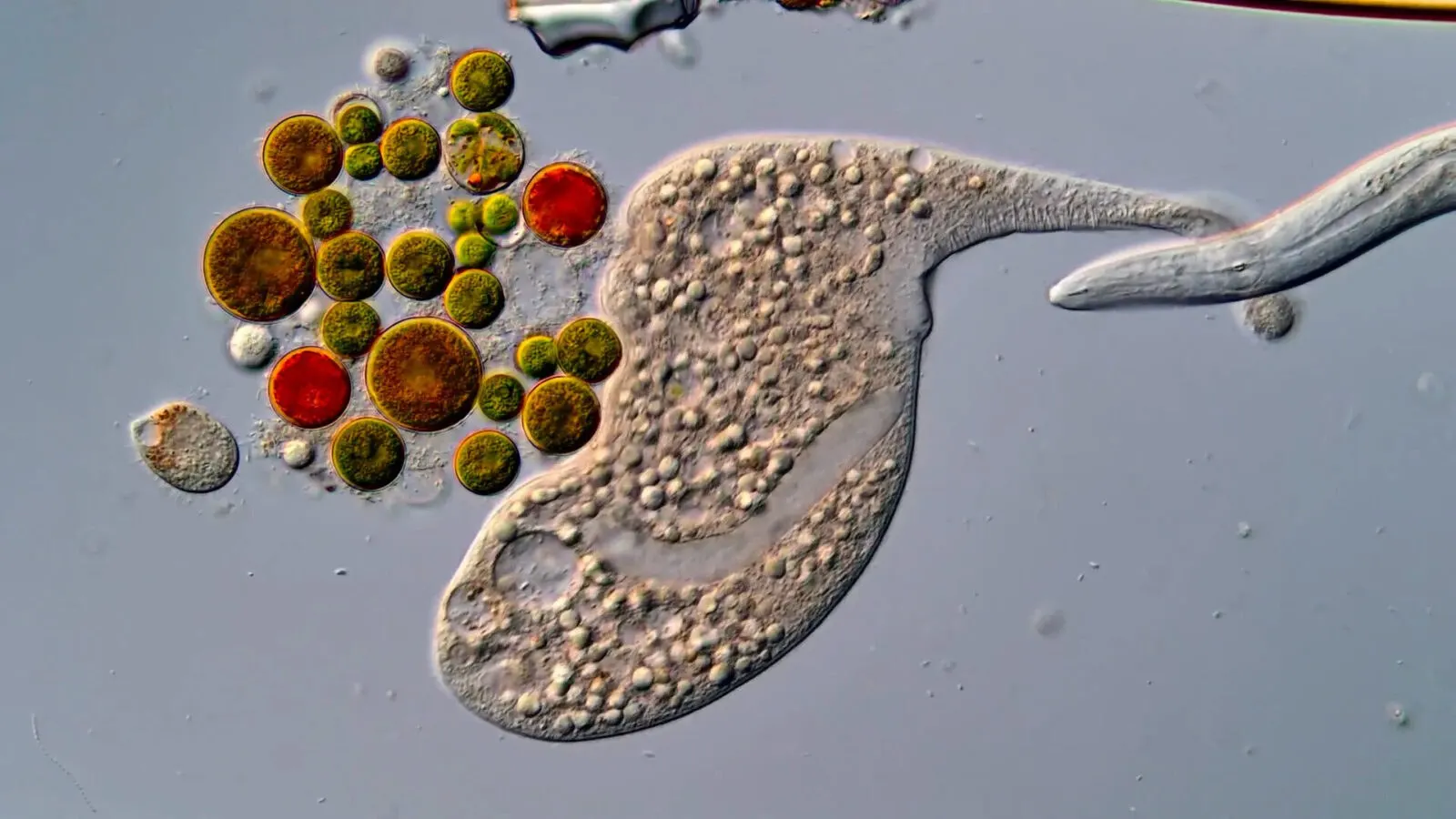
The new first place goes to Nguyen Nam Nhat of Chu Se, Gia Lai, Vietnam, for "A tiny roundworm and a single-celled Dileptus explore their microscopic world", filmed with differential interference contrast at 40X - the still above, from Nikon's gallery. Second is Benedikt Pleyer of Kirchberg, Bavaria, for "Jellyfish larvae suspended in water droplets" (darkfield, 25X); third is Dr Andrew Moore of the Howard Hughes Medical Institute's Janelia Research Campus for "Synchronized cell division in neighboring cells" (confocal, 63X).
Sources & further reading
- 01Nikon Small World - Nikon Small World in Motion Video Statement (9 Oct 2026) ↗Primary
- 02Nikon Small World - 2026 Small World in Motion Competition gallery ↗Primary
- 03The Verge - Nikon microscopic video competition winner disqualified for using generative AI (Stevie Bonifield, 9 Oct 2026), citing the BBC and the entrant's LinkedIn comment ↗Attributed