
Real Estate/News
NAHB: 45 of 47 construction occupations sit in the BLS's low or moderate AI-exposure bands; only managers and inspectors rate high
An NAHB reading of the Bureau of Labor Statistics' new AI-exposure table, published 1 October. The measure says whether AI could assist with a job's tasks; the BLS says it does not predict job losses - which is not how the trade press carried it.
By Daily Aletheia · Checked against the primary source · 3 October 2026 · 2 min read
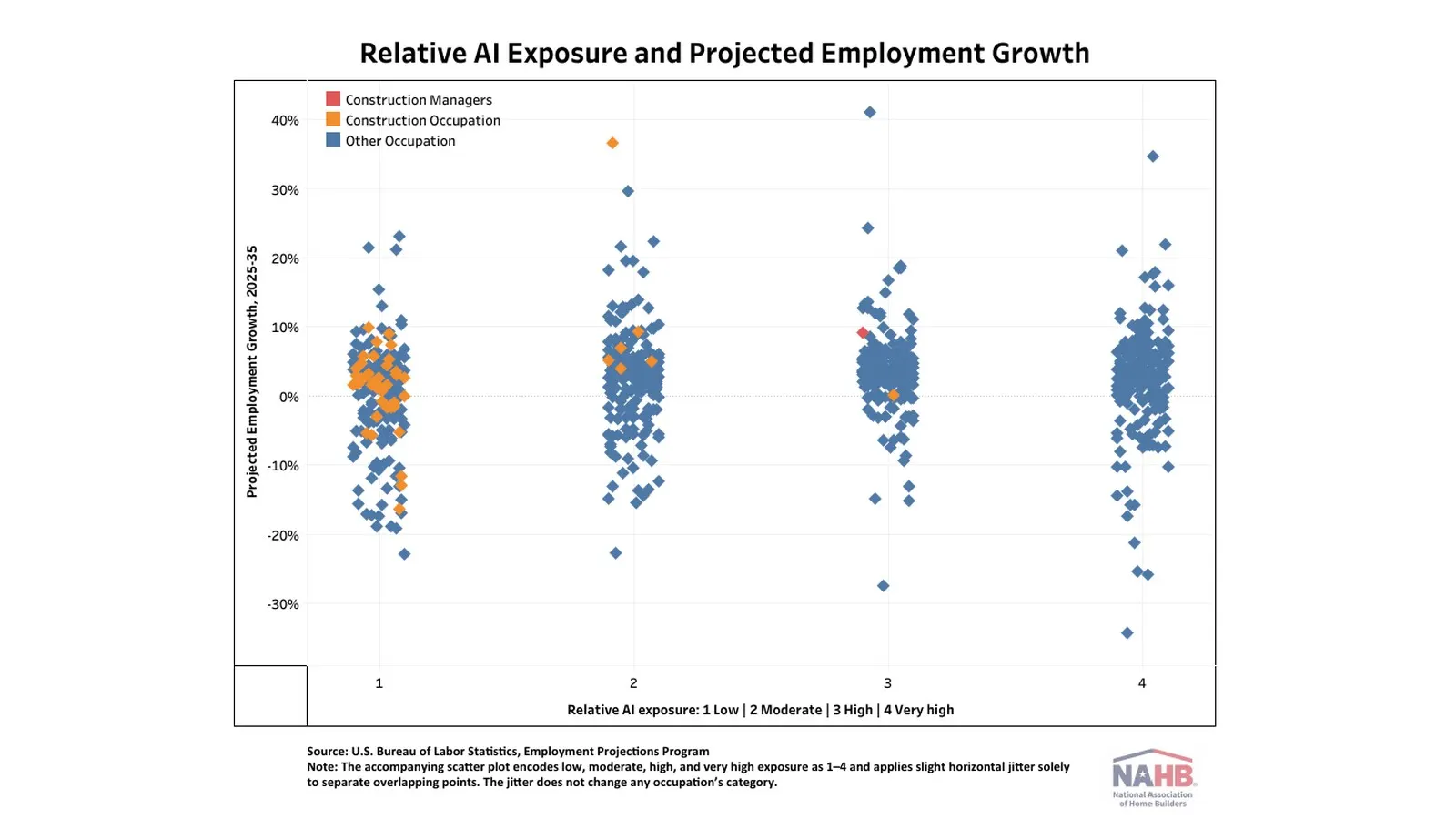
The National Association of Home Builders published an analysis on 1 October, by economist Jing Fu, of the Bureau of Labor Statistics' new table "AI Exposure Categories and Employment Projections, 2025-35". Of 47 selected construction-related occupations, 45 - about 96 per cent - are classified as having "low" or "moderate" relative AI exposure. Two are classified "high": construction managers, and construction and building inspectors. None is "very high".
What the chart shows
NAHB plots each occupation's exposure band against the BLS's projected employment growth from 2025 to 2035, and finds no neat relationship between the two. Construction managers, in the high band, are projected to grow 9 per cent; inspectors, also high, to stay essentially flat. Solar photovoltaic installers, in the moderate band, are projected to grow 37 per cent - the fastest of the group.
The low band holds the hands-on trades: carpenters, construction labourers, roofers, operating engineers. NAHB's explanation is that these jobs "rely heavily on physical execution, changing jobsite conditions, safety judgment, coordination with other trades, and interaction with materials and equipment", which limits what software-based AI can reach. Managers and inspectors rate higher because of "planning, documentation, scheduling, compliance, reporting, and communication". That matches what builders told NAHB's Housing Market Index survey: when they use AI it is for advertising and marketing, project planning and project design.
What the measure is not
NAHB is careful about the table's limits, and the caveats are the BLS's own: the measure "indicates whether AI technology could be, or has been, used to assist with or complete some tasks performed in an occupation" and "does not predict job losses, automation, productivity gains, or wage effects". The 47 occupations exclude extraction work and leave out the architects, engineers, estimators, accountants and sales staff that construction firms also employ; and occupations are counted whatever industry employs them.
Low exposure now, NAHB adds, does not insulate the industry. It expects AI to arrive first as faster estimating and planning, document management, safety analysis, progress monitoring and decision support, with changes on site coming "more gradually through AI-enabled equipment, robotics, and computer vision".
The Check
- What was said
- HousingWire, 2 October: "AI risk remains low for most construction jobs" and "most construction jobs face relatively low near-term job-loss exposure".
- What the Source Says
- The BLS measure, as NAHB quotes it, "indicates whether AI technology could be, or has been, used to assist with or complete some tasks performed in an occupation. Importantly, it does not predict job losses, automation, productivity gains, or wage effects."
- The Difference
- Exposure is not risk and not job loss. The table says whether AI could help with a job's tasks; it says nothing about whether the job goes. HousingWire's own footer says the article "was generated using HousingWire Automation and reviewed by a HousingWire editor".
Sources & further reading
- 01NAHB Eye on Housing - AI Exposure Remains Relatively Low Across Most Construction Occupations (Jing Fu), 1 Oct 2026 ↗Primary
- 02US Bureau of Labor Statistics - Artificial Intelligence (AI) exposure categories (the table NAHB reads; the page refused our reader at its edge - cited as NAHB quotes it) ↗Attributed
- 03HousingWire - AI risk remains low for most construction jobs, NAHB finds, 2 Oct 2026 (coverage, for the check) ↗Attributed