
AI/News
Hinton, Bengio and scientists from OpenAI and Anthropic: automating AI research could compress years into months
A Cambridge working paper with 22 authors says AI now writes most of the code inside the labs and that most AI R&D could be automated within a few years. Its headline acceleration figure rests on estimates the paper itself calls substantially uncertain.
By Daily Aletheia · Checked against the primary source · 30 September 2026 · 3 min read
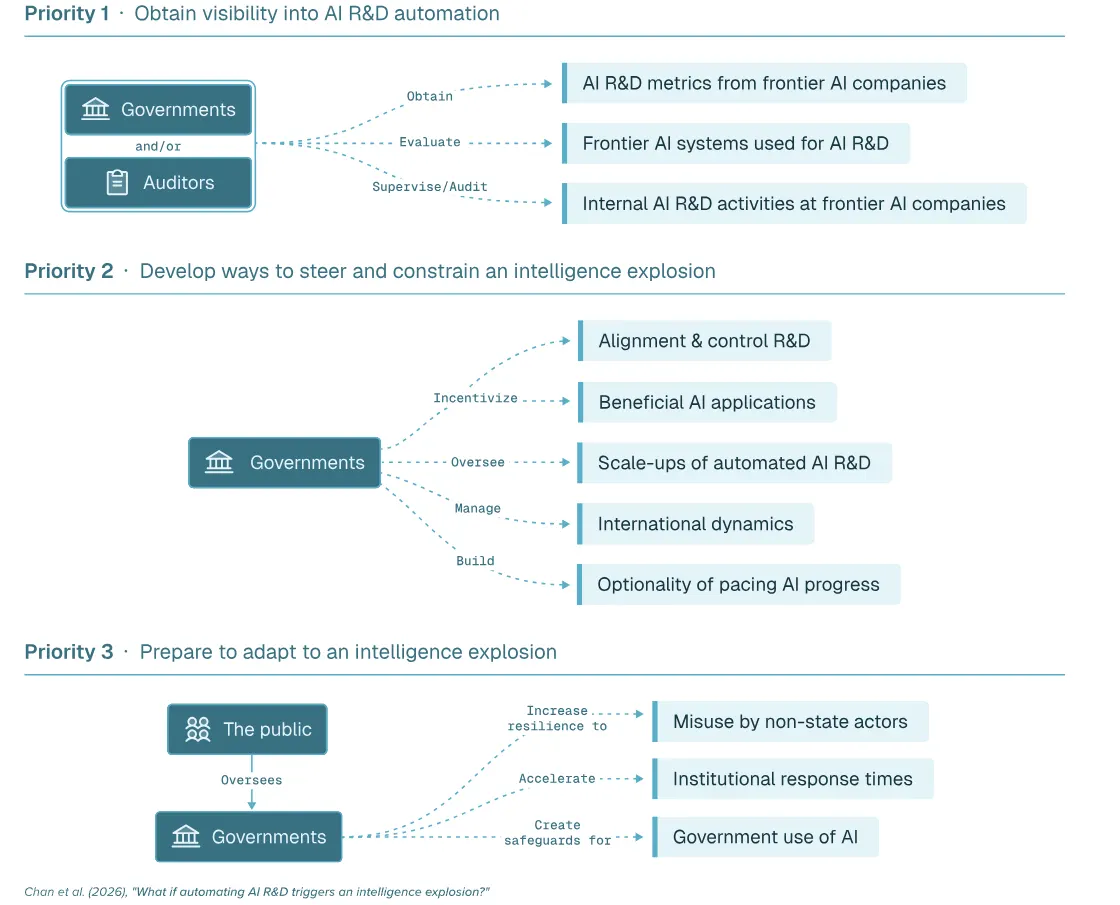
A working paper published on 28 September by the Cambridge Programme on AI Science & Policy asks what happens if the labs succeed in automating their own research. The 22 authors include Geoffrey Hinton, Yoshua Bengio, OpenAI's chief scientist Jakub Pachocki, Anthropic co-founder Jack Clark, Microsoft's Eric Horvitz and Dawn Song of Berkeley, writing in a personal capacity.
What the paper says
"In contrast to even a year ago, AI systems now write most of the code inside the companies that build them," the abstract opens. The paper cites Anthropic's figures: AI's share of approved code rose from low single digits to over 80% between January 2025 and May 2026, and the share of R&D work completed autonomously with only high-level human supervision rose from 1% to 26% between March and August 2026.
The authors say AI systems "are on track to automate most AI R&D work within a few years, and possibly all of it". Some tentative extrapolations, they write, suggest months-long AI R&D projects will be automated by mid-2028.
The mechanism is a loop: better AI expands the effective research workforce, which builds better AI. At expert level, the paper estimates, one frontier developer's compute could sustain a workforce equivalent to at least millions of top human researchers.
The numbers that travelled
Using published estimates of the returns to research effort of between 1.2 and 1.9, the paper says the pace of AI progress could increase tenfold within about 18 months of full automation, at which point a year of today's progress would take about five weeks. It adds in the same paragraph that "uncertainty is substantial" and names four frictions that could slow the loop: diminishing returns, limits on compute and data, hard-to-automate tasks, and long training runs.
The three risks named are that capabilities outpace society's ability to adapt, that humans lose control of superhuman systems, and that checks on power erode. The asks of governments: visibility into how far the labs have automated their own R&D, ways to steer and constrain an acceleration, and preparation for its impacts.